Context
LLM-generated content is written into persistent storage alongside human-verified data, and downstream features and users will read it. Some of it has been checked, most has not, and once stored the two look identical.
Examples
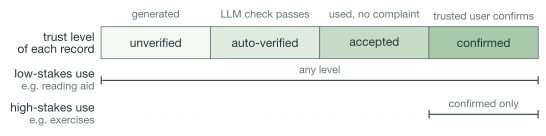
A meaning (a word paired with a translation) can exist at several trust levels: generated by Google Translate (unverified), verified by an LLM-Checking-LLM pass (auto-verified), implicitly accepted (a learner drilled it in an exercise without flagging it as wrong), or explicitly corrected by a trusted user, such as a teacher. Each level carries different confidence, and the system can make different decisions depending on the validation state: for example, only including explicitly confirmed translations in exercises, while using auto-verified ones for reading assistance where the stakes are lower.
Simplified articles carry a similar state, arrived at differently. Each stored version has a broken flag that keeps it out of what learners are offered, and it is set three ways: an automatic quality check at generation time, an audit tool that finds versions the LLM wrote in the wrong language, and readers themselves, since three reports mark an article broken.1
What the state is for differs in each case. A meaning’s level is read on every exercise that might use it, and grades how the meaning may be used. A version’s flag is read when a reader asks for a level, and excluding a version is also what causes it to be replaced: the on-demand path calls the LLM only when it finds no usable version at that level. One gates use; the other gates use and triggers repair.
Problem
How can trusted and untrusted LLM-generated data be told apart after it lands in the database, so each is used according to its confidence?
Forces
- Unmarked data is silently trusted. Once stored, LLM output is indistinguishable from human-verified data, so without a marker downstream features treat unverified output as ground truth. (pushes toward tracking trust at all)
- Different consumers can tolerate different confidence. Reading assistance is fine with an unverified translation; a word promoted into drills should be confirmed first. Serving both well means distinguishing levels of trust, not just verified from unverified. (pushes toward a richer trust spectrum)
- Every level is state to maintain. Each level is another transition to model, set on write and update on every validation event, so too fine a spectrum is maintenance burden and false precision. (pushes toward the coarsest spectrum that still supports the decisions)
Solution
Maintain an explicit, queryable validation state for all LLM-generated content in the data model. Never let LLM-generated content silently become trusted data. The validation state may be a simple flag, but more often it is a spectrum or state machine reflecting different levels of trust (e.g., unverified → auto-verified → implicitly accepted → explicitly confirmed by a trusted user; alternatively, one could track the number of users that have validated a given content).
Consequences
- Each consumer can gate on trust. Exercises use only confirmed pairs, reading assistance can fall back to auto-verified ones, and unverified output never silently becomes ground truth.
- The data model carries an extra state to maintain. It must be set on every write and updated on every validation event, and the right granularity (a flag, a spectrum, or an agreement threshold: N independent users confirming before it counts as trusted) is a domain judgment.
- It pairs with provenance to describe any stored artifact. Where LLM Output Provenance records how an artifact was made, this records whether it has been confirmed; together they answer both questions about a stored artifact.
Known Uses
- Argilla, an open-source platform for annotating and reviewing model-generated data, gives every record an explicit status: a model suggestion starts as pending, becomes a draft and then submitted as someone works on it, and ends up validated or discarded. A suggestion is never treated as correct until a human has moved it to validated.
- Label Studio, another annotation tool, flags each item as ground truth or not and records whether it has been reviewed, so human-verified “gold” data stays clearly separate from unreviewed model predictions.
- Snorkel (Ratner et al., VLDB 2017) attaches probabilistic confidence to programmatically generated labels rather than treating them as ground truth: a confidence spectrum rather than a discrete state machine.
Together the three bracket the granularity this pattern turns on: a multi-state lifecycle (Argilla), a binary gold/not-gold flag (Label Studio), and a probabilistic score (Snorkel).
Note. The examples above are data-labeling platforms; a documented, in-product LLM-output trust-state lifecycle (as opposed to human-annotation state) remains thinly evidenced: one reason we keep this among the less-settled patterns.
Notes
- This pattern complements LLM Output Provenance. Together they answer two essential questions about any piece of LLM-generated data: how was it produced? and has anyone confirmed it’s correct? The right granularity of validation tracking depends on the domain: some systems may need binary (verified/not), others may need multiple validators with agreement thresholds, and others, like Zeeguu, benefit from a trust spectrum that reflects different forms of implicit and explicit user feedback.
- Implicit signals are weaker than explicit ones. A word drilled in exercises without ever being flagged is a positive signal, but a weak one, which is why it sits below a correction from a trusted user in the trust order.
💬 Open an issue about this pattern
-
Article.broken,UserArticleBrokenReport, andavailable_simplified_versionsin thezeeguu/apirepository. ↩