Context
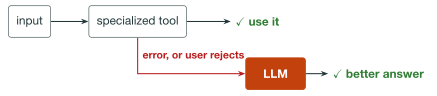
A feature can be produced two ways: a cheap, fast specialized tool (a translation API, a classical classifier) that is adequate for the common case, and a slower, costlier LLM that does better on the hard cases. Crucially, the cheap tool’s shortfalls are observable: it either errors, or the user visibly rejects the result.
Examples
In Zeeguu, translation APIs (from Google, Azure, and DeepL) serve as the primary translation engines. When a user indicates the translation is inadequate (by choosing Ask an AI from the alternatives menu), the system escalates to an LLM for a more nuanced, context-aware translation. This keeps costs low and speed high in the common case while providing higher, LLM-quality results when needed.
 is the primary path; when the user wants a better rendering they escalate to an LLM on demand via the "[Ask an AI](../zeeguu/#translation)" option.](/images/escalate-to-the-llm.png)
A second escalation in the same system fires without the user. When the parts of a multi-word expression are separated in a sentence (German ich rufe dich morgen an, where dich morgen splits rufe from an), the translation APIs receive a fragment that has lost its context and return a poor rendering. That separation is visible in the parse, so the system escalates to the LLM on its own, passing the whole sentence rather than the fragment.1
These two escalations differ in how they are triggered, and the difference has a cost. The user-triggered one needs UI surface and puts the routing burden on the reader. The automatic one costs neither, but it is only possible because a separated expression is visible in the parse before the cheap tool has run. Where a shortfall cannot be detected in advance, the user is the only signal left.
Problem
LLM quality is only worth its cost on the minority of requests the cheap tool handles poorly, and those cannot be told apart up front. How can the LLM be spent only where it pays off?
Forces
- Quality on the hard cases. Specialized tools (translation APIs, NLP pipelines, classical classifiers) are faster, cheaper, and more deterministic than an LLM for well-defined tasks, but on a minority of inputs they fail or fall short, and there the LLM tends to do better. (pushes toward escalating)
- Cost, latency, and usability. Each escalation adds the LLM’s cost and, because it runs after the cheap path, doubles the wait for that request; when the trigger is a user signal, it also costs UI surface and puts the routing burden on the user. (pushes toward escalating rarely, and automatically where possible)
- The hard cases cannot be told apart up front. The system cannot know which inputs the cheap tool will handle poorly before running it, so escalation must fire on an observable signal: the tool erroring, or the user rejecting the result.
Solution
Use the specialized tool as the primary path and escalate to the LLM only when the primary fails or the user signals dissatisfaction. The LLM receives the original input, and (where it helps) the specialized tool’s output and the user’s feedback alongside it, so the escalation refines rather than restarts.
Consequences
- Cheap in the common case. The LLM runs only on failure or dissatisfaction, so the vast majority of requests never incur its cost or latency.
- User-triggered escalation costs usability. Unless it fires automatically on a detectable failure, the user must be given, and must notice and use, a way to signal dissatisfaction: extra UI surface, and the routing burden falls on them.
- A miss doubles the wait. When escalation happens the user has already waited for the cheap result first, so time-to-answer for those cases is the sum of both.
Known Uses
FrugalGPT (Chen, Zaharia & Zou, 2023) escalates when a scorer rejects the cheap answer, and RouteLLM (Ong et al., 2024) trains a confidence router that sends only the hard queries to the strong model. Both decide automatically from the model’s own confidence, the model cascade variant of escalation discussed in the Notes below. The external-signal trigger this pattern centers on (the primary tool erroring, the input arriving in a shape the tool handles badly, or the user rejecting the result) is less documented; the two Zeeguu escalations above are our instances of it.
Notes
- Applies broadly. Beyond translation: topic classification, named entity recognition, or any task where a cheaper tool handles the common case and the LLM handles the long tail.
- Escalation, not fallback. Unlike a reliability fallback (where the secondary is an equal-or-lesser backup invoked when the primary fails), here the secondary is more capable and more expensive, invoked when the primary is not good enough. The movement is up in quality and cost, not down into degraded mode. That is why we name it escalation.
- Relationship to the model cascade. This is the human-/failure-triggered cousin of the model cascade in ML serving, where a cheap model runs first and a confidence threshold routes hard inputs to a larger model. The shared shape is cheap tier first, expensive tier on demand; the difference is the trigger. A cascade escalates automatically on the model’s own low confidence, whereas this pattern escalates on external signals: the primary tool erroring, or the user explicitly declaring the result inadequate. A confidence-based cascade is thus one possible escalation policy; user dissatisfaction is another, and the two can be combined.
- A black-box primary exposes no confidence to threshold on. Zeeguu’s translation APIs (Google, Azure, DeepL) return a translation but no calibrated per-request confidence, so the internal-confidence trigger a model cascade relies on is not even available here; the escalation signal has to come from outside the tool, its erroring or the user rejecting the result.
💬 Open an issue about this pattern
-
translate_separated_mwein thezeeguu/apirepository. ↩