Context
A single LLM model identifier is referenced from many call sites across a codebase. Providers retire dated model snapshots on their own schedule, so an ID that is valid today can start returning 404 at a future date with no change to the code.
Example
Zeeguu’s reader has an on-demand “Ask AI” translation action. Its model ID, claude-sonnet-4-20250514, was hardcoded at three call sites in the translation service and two more in the multi-word-expression (MWE) detector. Anthropic retired that snapshot; every call began returning 404 not_found_error. The error was swallowed one layer down (the helper returns None on any exception), so the endpoint returned a generic 404 "LLM translation failed" and the reader silently degraded to an “Ask AI, try again” button that could never succeed.
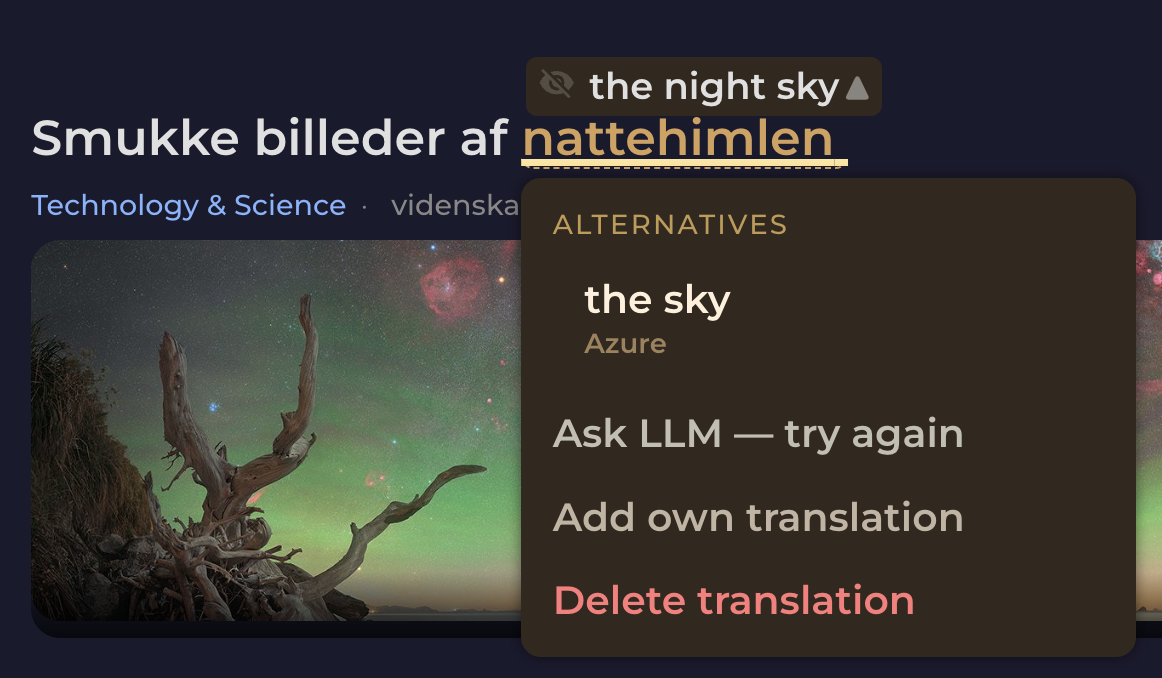
Nothing in the code had changed; a date had passed. The error started showing up.
The fix itself was mechanical: swap to the live snapshot the rest of the codebase already used. But finding it took a dig through production logs, and the swap had to be repeated at five sites.
To avoid this happening again in the future, Zeeguu now keeps every model identifier in one module, keyed by role, the job a model does in a feature (WORD_TRANSLATION, MWE_DETECTION, SIMPLIFICATION, …), and each resolving to a canonical vendor ID declared once; a feature asks for models.WORD_TRANSLATION and never names a snapshot, so the next retirement is a one-line edit.
Problem
How can a provider’s model retirement be survived without hunting down every hardcoded model ID scattered across the codebase?
Forces
- Model identifiers are volatile in a way ordinary configuration is not
- Providers deprecate and retire dated snapshots on their schedule, so a hardcoded ID that works today returns a 404 at some future date, with no change to the code at all.
- Model choice is also cross-cutting: the same handful of IDs get copy-pasted across many features and several cost/quality tiers, so a single retirement breaks many call sites at once, and there is no one place to see, or change, which model each feature uses. Because the failure is a runtime error on a string that looks perfectly valid, it survives code review and type-checking.
Solution
Keep every model identifier in one central module. Declare the canonical vendor IDs once, then expose role-based aliases (one per use: translation, classification, simplification…) that resolve to them. Call sites import the role, never the raw string. Surviving a vendor retirement, or moving one feature to a cheaper or faster tier, becomes a one-line change in a file that documents the whole model landscape on one screen.
Consequences
- A retirement is a one-line edit. Surviving a deprecation, or re-pointing a feature to a cheaper or faster tier, changes one line in a module that shows the whole model landscape on one screen, rather than a hunt across call sites.
- The registry only helps if nothing bypasses it. It adds one layer of indirection, and a single stray hardcoded ID reintroduces the exact failure the pattern prevents, so the discipline has to hold everywhere.
- One constant keeps selection and provenance in sync. Because the same central constant both selects the model and stamps it onto output, the two cannot drift (composes with LLM Output Provenance); it also names which model each entry of a Fail-Fast Provider Chain uses.
War Story
The same commit that repaired the retirement uncovered a second casualty of the identical disease. Simplified articles were being stamped ai_model="claude-3-5-sonnet" while the simplifier had long since moved to Haiku. The provenance field named a model that was no longer even in the pipeline (see LLM Output Provenance). Same root cause as the retirement: a model identifier duplicated into a place nobody remembers to update, silently going stale. Centralizing selection lets the provenance stamp and the call-time choice read from the same constant, so they cannot disagree.
Known Uses
- Sourcegraph Cody binds each feature role (
chat,fastChat,codeCompletion) to amodelRefin a centraldefaultModelsmap, so changing which model powers a feature is a single config edit rather than a call-site change: genuine role-based central selection in a shipped product. - The mechanism is the classic single source of truth; what makes it LLM-specific is vendor-driven model deprecation (see this pattern’s forces). We did not find a public first-hand account of centralizing model IDs in response to a deprecation outage: Zeeguu’s is our instance.
Notes
- The mechanism is classical (single source of truth; no magic strings). What makes it an LLM pattern is the force: vendor-driven model deprecation turns an innocuous hardcoded string into a scheduled runtime failure. It is the direct defense against the “old ones regularly deprecated” property listed among the core LLM forces in the introduction.
- Prefer role-based aliases over vendor-based constants.
WORD_TRANSLATION = HAIKUreads as intent and lets one re-point a single feature’s tier without touching others; a bareHAIKU = "claude-haiku-…"re-exported everywhere quietly couples unrelated features to the same choice. - Alternative: AI gateway. An AI gateway can host the role→model mapping as named aliases in its config, relocating this pattern’s registry out of application code. See the broader treatment of what gateways do and do not subsume in What Makes These Patterns LLM-Specific? → Relationship to LLM Gateways.
- Enablers (not instances). Gateways relocate the role→model map into their config as aliases (LiteLLM model aliases, Portkey Model Catalog): the same mechanism, hosted outside app code.